
In engineering sites for surveillance, communications, and industrial networks, doubts frequently arise regarding whether signal Surge Protective Devices (SPDs) actually work. It is not uncommon to see damaged switch ports, IP‑camera Ethernet ports, routers and other hardware even after power‑supply SPDs have been installed. This leads many to question: are signal SPDs truly necessary?
The answer is: signal SPDs deliver tangible protective effects on signal lines exposed to risks of lightning‑induced surges and transient over‑voltages. Nevertheless, they only address surges on signal circuits and cannot replace comprehensive system‑wide lightning protection.
Many believe that since network cables operate at low voltage, they face minimal lightning‑strike hazards.
In fact, the risk does not stem from the cable’s normal operating voltage, but from the extremely high transient over‑voltage that can appear on the line the instant a lightning strike occurs.
When lightning strikes, powerful lightning current generates rapidly varying electromagnetic fields in surrounding space. Long nearby network cables, communication lines and control cables may pick up transient over‑voltage via electromagnetic induction.
This risk is amplified for outdoor cameras, inter‑building networks, on‑site industrial communication equipment and long‑distance wiring, where cables have greater exposure to lightning electromagnetic pulses.
These transient over‑voltages are extremely short‑lived, yet sufficient to cause port breakdown, communication failure or even permanent damage to the highly integrated electronic components inside switches, routers and IP cameras.
Low operating voltage therefore does not equal low surge risk.
A network SPD acts as a transient over‑voltage barrier installed between network cabling and protected end‑equipment.
Under normal communication conditions, network signals pass through the SPD with minimal interference to regular data transmission.
When abnormal transient over‑voltage occurs on the network line, internal protection circuitry activates rapidly to clamp and divert surges. It limits the transient over‑voltage arriving at the equipment’s Ethernet port, lowering the risk of surge‑induced damage to downstream ports.
Accordingly, a network SPD primarily protects communication interfaces and their downstream electronic circuits — not necessarily the entire piece of equipment. This layer of protection is particularly critical for switches, hubs, routers, IP cameras and other TCP/IP‑enabled devices.
One key distinction between signal surge protection and power‑supply surge protection lies in the equal importance of signal performance alongside protective capability.
Network cables carry high‑speed data traffic. Even excellent surge‑suppression performance is rendered useless if the SPD introduces excessive insertion loss, bit‑error rates or other signal impairments.
A well‑designed network signal SPD must satisfy two requirements simultaneously: ‑ Rapidly clamp transient over‑voltage when surges occur; ‑ Avoid meaningful degradation of normal network data transmission under operating conditions.
This represents the core design challenge for network signal SPDs.
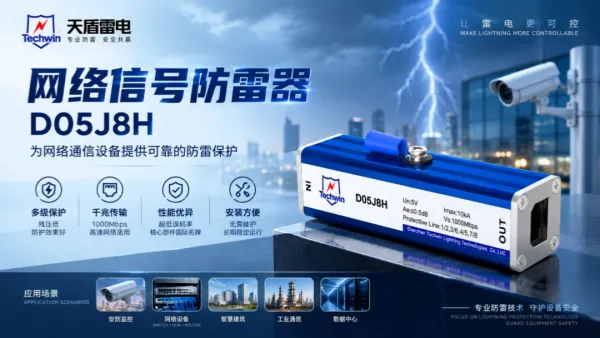
To address lightning‑surge protection requirements for TCP/IP communication networks, TECHWIN has launched the D05J series network signal SPDs for surge protection on signal lines feeding switches, hubs, routers and other network hardware.
D05J4 is designed for 100 Mbps networks.
D05J8H is engineered for 1000 Mbps Gigabit networks.
Select the appropriate model according to the actual network transmission rate during engineering specification.
Adopting multi‑stage protection circuitry, the products reduce residual voltage while maintaining low insertion loss to minimize impact on normal communications after installation.
Isolation‑blocking technology plus line‑to‑line voltage‑limiting schemes suppress transient over‑voltage on network lines, balancing discharge capacity, transmission performance and response speed.
For security surveillance, industrial networks, communication facilities and other TCP/IP‑based systems, deploy network signal SPDs on relevant lines based on cable exposure, equipment criticality and local lightning risk. Used together with power SPDs, they establish multi‑path surge protection for field devices.
Returning to the original question: do signal SPDs work?
The answer is straightforward. Where network lines face risks of lightning induction and transient over‑voltage, network signal SPDs form a vital protective barrier preventing surges from striking equipment interfaces via communication cabling.
They are not “fit‑and‑forget” standalone solutions.
Truly effective network lightning protection demands holistic consideration of power lines, signal wiring, mounting location, earthing and equipment withstand capability.
For high‑risk scenarios such as outdoor surveillance, inter‑building communications, industrial automation and communication rooms, it is preferable to secure the often‑overlooked surge entry path of network cabling in advance, rather than troubleshooting repeated port failures after damage has taken place.
The purpose of lightning protection is never to guarantee that every lightning strike can be “blocked”. Instead, properly graded and line‑specific protection reduces the probability of surge‑caused equipment damage to the greatest practical extent.
This embodies the true value of network signal surge protective devices.
 Frequent Video Monitoring Failures in Wind Farms? The Problem Might Be HereApril 23, 2026Frequent Video Monitoring Failures in Wind Farms? The Problem Might Be HereIn the operational system of a wind farm, video monitoring plays a vital role in equipment inspection, safety management, and...viewPhotovoltaic Power Generation Systems and Lightning Protection Measures for Photovoltaic SPDJune 26, 2024Since the main components of the solar photovoltaic power generation system are outdoors, they are prone to lightning strikes or high-voltage surge induction, causing equipment damage. This article wi...viewWhat is A Surge protective device(SPD)? How to install it in an AC power system?April 16, 2025A Surge Protective Device (SPD) is a critical component designed to safeguard electrical systems and equipment from voltage surges caused by lightning strikes, power grid fluctuations, or switching tr...viewHow to connect a surge protector?March 3, 2023Connecting surge protectors in an industrial setting requires additional considerations and precautions compared to connecting surge protectors in a residential setting. Here are some general steps to...viewImportant differences between IEC 61643-01:2024 and IEC 61643-11:2011: ---Interpretation of the new standard for surge protectorsDecember 12, 2024The surge protector is an electronic device that provides safety protection for various electronic equipment, instruments, and communication lines. According to its use, it can be divided into power s...viewWhat Are the Effects of Surge Protectors?April 26, 2022SPD surge protection device is an electrical equipment used to limit transient overvoltage and discharge surge current. It is also called lightning arrester, which is an important part of the internal...view
 EN
EN
 jp
jp  ko
ko  fr
fr  de
de  es
es  it
it  ru
ru  pt
pt  ar
ar  vi
vi  th
th  ro
ro  bg
bg  nl
nl