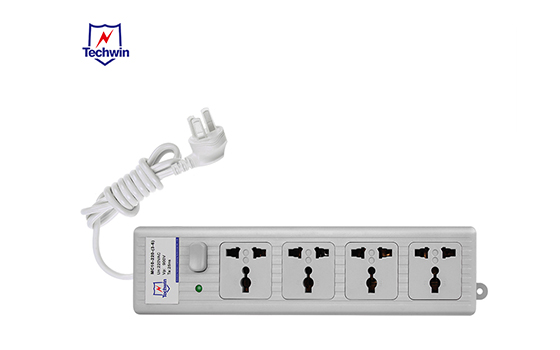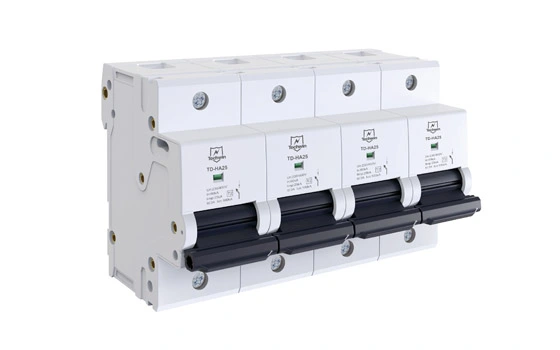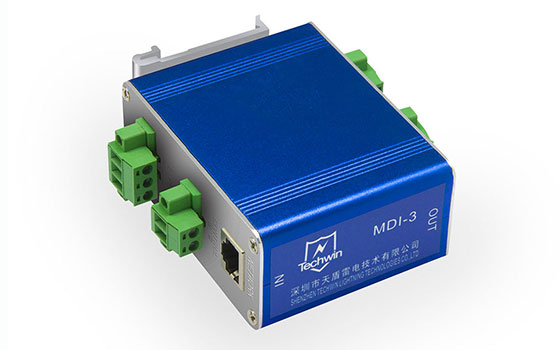

A surge protector, also known as a lightning arrester, is an electronic device that provides safety protection for various electronic devices, instruments, and communication lines. When a sudden spike in current or voltage occurs in an electrical or communication circuit due to external interference, the network surge protector can quickly conduct and shunt, thereby avoiding damage to other devices in the circuit caused by surges.
A surge protector is suitable for protecting against surges caused by indirect or direct lightning strikes or other transient overvoltages in power supply systems with an alternating current of 50/60HZ and a rated voltage of 220V/380V. It is suitable for the surge protection requirements of residential properties, tertiary industries, and industrial fields. Regardless of where it is used, a signal surge protector is an indispensable asset for protecting electrical equipment from damage and ensuring their operational reliability. With high-quality surge protection devices from reputable brands, it is possible to safeguard electrical systems and minimize the risks of power damage or failure, providing peace of mind to users and helping to maintain the integrity of electrical systems.
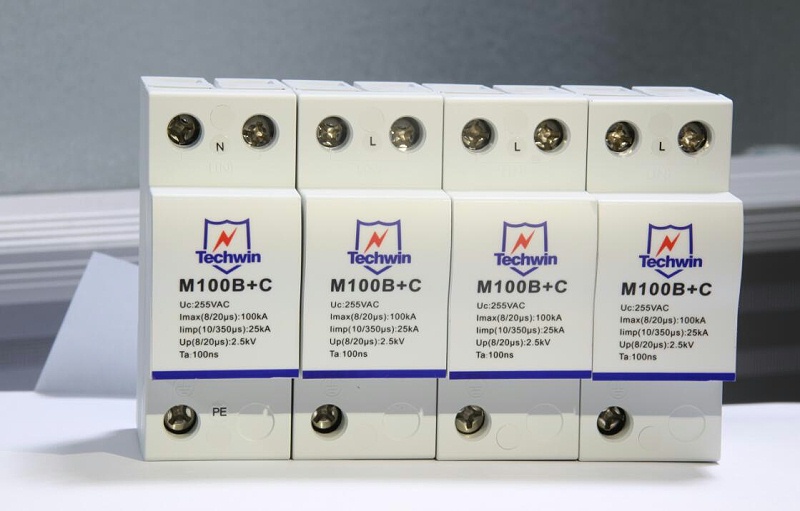
For customers who are working on projects and need to know which model of surge protector to use for distribution boxes, they first need to know the level of distribution and whether a high-end surge protector has been installed on the main distribution before the distribution box. Generally, a level one surge protector (M100B+C/3+N) is required for the main distribution, and a level two or three surge protector (M40B4) is required for the distribution box.
Secondly, the installation location of the distribution box needs to be considered. If it is installed outdoors, a level one surge protector is necessary. If it is a distribution box for equipment, it should be a level three surge protector, but if outdoor wiring is used, it is recommended to choose a level one surge protector (M100B+C/3+N) because it has a long service life and good protective effect.

Finally, surge protectors should be installed on the incoming cabinet and other cabinets in areas where thunderstorms are likely to occur. A level one surge protector with a maximum discharge current greater than 60KA (M60B4) should be selected for the incoming cabinet, and 20-40KA surge protectors can be selected for other cabinets. If the area does not have a high probability of thunderstorms, surge protectors can be installed in the incoming cabinet or special equipment. The models of high-end surge protectors are named by the manufacturer according to their parameters, and each surge protection devices manufacturer has different naming rules and model numbers.
The earliest type of surge protector was the lamb horn gap, which appeared in the late 19th century and was used for overhead transmission lines to prevent power outages caused by damage to equipment insulation by lightning strikes. In the 1920s, aluminum surge protectors, oxide film surge protectors, and pellet-type surge protectors appeared. In the 1930s, tube-type surge protectors appeared. In the 1950s, silicon carbide lightning arresters appeared. In the 1970s, metal oxidenetwork surge protectors appeared. Modern high-voltage surge protectors are not only used to limit overvoltage caused by lightning strikes in power systems, but also to limit overvoltage caused by system operations. Since 1992, industrial control standards represented by German and French 35mm rail-mounted pluggable SPD lightning protection modules began to be imported into China on a large scale, and later, integrated box-type power lightning protection combinations represented by the United States and the United Kingdom also entered China.
 The Difference Between a Lightning Arrester and a Surge ProtectorDecember 8, 20211. What's a surge protection device (SPD)?A surge or spike refers to a transient over-voltage that is far larger than the specified operating voltage. In essence, it is a strong impulse with the d...viewWhat is the Difference Between a Class 1 Lightning Surge Protector and a Class 2?November 9, 2021Since the energy of lightning strikes is very huge, it is necessary to gradually discharge the energy of lightning strikes to the ground through a hierarchical discharge method. The first-level lightn...viewHow Long is the Service Life of the Power Surge Protector SPD?February 17, 2023The internal components of the power surge protector SPD, such as gas discharge tubes, varistors, transient suppression diodes, etc., will have a certain impact on the performance when subjected to cu...viewWhat Are the Commonly Used Lightning Protection Components?March 13, 2023External lightning protection system, consisting of lightning rods (or lightning conductors), down conductors, and grounding system, is mainly designed to protect buildings from lightning strikes whic...viewAntenna Surge Protective Device for Cellular Base StationsJuly 3, 2024Currently, the world is experiencing significant changes, including planning and establishing new mobile radio sites, as well as revitalizing and expanding existing network infrastructure. In the era ...viewWhat Are the Classification Protection of Lightning Protection System?January 10, 20221. Type 1 lightning protectionThe aim is to prevent voltage surge from being directly conducted from LPZ0 to LPZ1 and limit the voltage surge varying from tens of thousands of volts to hundreds of tho...view
 EN
EN
 jp
jp  ko
ko  fr
fr  de
de  es
es  it
it  ru
ru  pt
pt  ar
ar  vi
vi  th
th  ro
ro  bg
bg  nl
nl