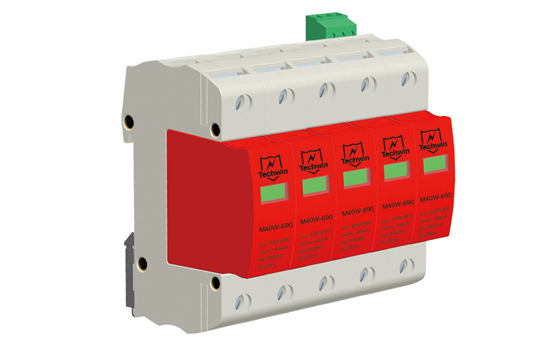

Surge protectors (SPDs) can effectively reduce the risk of electrical fires caused by surges when designed, installed and maintained in accordance with international standards (such as the IEC 61643 series). Its core mechanism of action and fire protection capabilities are as follows:
SPDs use nonlinear components such as metal oxide varistors (MOVs) to limit transient high voltages (up to several thousand volts) generated by lightning strikes or operational overvoltages to within the tolerance range of the equipment, preventing short-circuit sparks caused by line insulation breakdown13.
Surge energy discharge
When induced lightning current (typically 10-40kA) intrudes, the spd surge protector switches to a low-resistance state within nanoseconds, dissipating the energy through the grounding system to prevent abnormal currents from accumulating in the conductors and causing overheating and fire25.
Multi-path protection
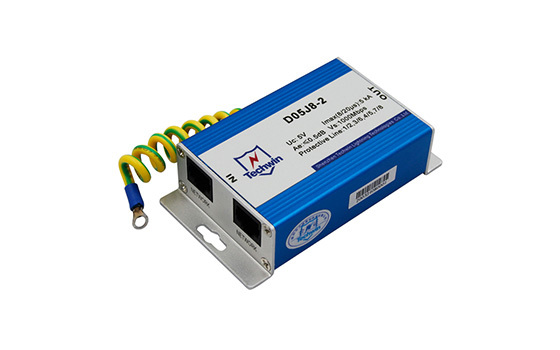
International standards require SPDs to protect power lines and signal lines (such as network/telephone lines) at the same time, blocking surge energy invading from non-power paths and reducing the possibility of fires from multiple sources58.
According to standards such as IEC 61643-11, the fire protection performance of SPDs must meet the following conditions:
Graded protection architecture
First-level protection (Type 1): Installed at the entrance of a building, discharging direct lightning induced current (≥12.5kA), residual voltage ≤4kV.
Second-level protection (Type 2): Secondary voltage limiting (≤2.5kV) in the distribution box to handle residual surge energy.
Third-level protection (Type 3): Fine protection close to the device end (≤1.5kV), suppressing microsecond overvoltage.
Safety tripping mechanism
SPD must be integrated with a thermal tripping device or equipped with a backup circuit breaker. When the MOV deteriorates and the leakage current exceeds the threshold (usually >3mA), the circuit can be automatically cut off to prevent continuous heating and burning68.
Power frequency follow-current suppression
SPDs that meet IEC standards must have built-in arc extinguishing technology, which can quickly restore the high impedance state after discharging the lightning current to avoid arc ignition caused by the power frequency voltage of the power grid.
Cannot protect against direct lightning strikes
The energy of direct lightning strikes (≥100kA) far exceeds the SPD's tolerance capacity, and it is necessary to rely on external lightning protection systems such as lightning rods (IEC 62305 regulations)13.
Degradation failure risk
After multiple actions, the MOV may increase the leakage current (>5mA) due to performance degradation, and needs to be monitored through the status indicator and replaced according to the IEC recommended cycle (usually 5-8 years)36.
Grounding system requirements
The grounding resistance must be ≤10Ω (IEC 60364-5-54), otherwise local overheating may occur due to poor discharge 28.
Surge protectors designed and installed in accordance with international standards can effectively suppress electrical fires caused by transient surges such as induced lightning and operating overvoltage, but direct lightning strikes require an external lightning protection system. At the same time, the IEC requirements for graded protection, backup protection and regular testing must be strictly followed to avoid secondary risks caused by SPD degradation itself
 What Are the Lightning Protection Systems Included in the Security Industry?March 13, 2023To know what lightning protection systems are available in the security industry, we must first understand the development and changes of the security industry. From the emphasis on "no AI, no se...viewWhat Are the Requirements of Grounding Resistance Testers on the Resistance Value of Grounding Resistance?September 18, 20211. Grounding resistance test meter's requirements for the resistance value of the grounding resistance(1) Independent lightning protection grounding resistance is≤ 10Ω.(2) Independent safety pro...viewBudgeting for Stability: The Cost-Effective Approach to SPD for Power SupplyJanuary 5, 2024In the intricate landscape of power management, Surge Protection Devices (SPDs) for power supply stand out as cost-effective guardians, ensuring stability without breaking the budget. This passage del...viewThe imortant technical characteristics of SPDSeptember 8, 2021Maximum continuous operating voltage UCThe maximum continuous operating voltage (old: rated voltage) is the maximum root mean square value (rms) of the allowable voltage applied to both ends of the su...viewWhat Are the Commonly Used Lightning Protection Components?March 13, 2023External lightning protection system, consisting of lightning rods (or lightning conductors), down conductors, and grounding system, is mainly designed to protect buildings from lightning strikes whic...viewThe Difference Between a Lightning Arrester and a Surge ProtectorDecember 8, 20211. What's a surge protection device (SPD)?A surge or spike refers to a transient over-voltage that is far larger than the specified operating voltage. In essence, it is a strong impulse with the d...view
 EN
EN
 jp
jp  ko
ko  fr
fr  de
de  es
es  it
it  ru
ru  pt
pt  ar
ar  vi
vi  th
th  ro
ro  bg
bg  nl
nl