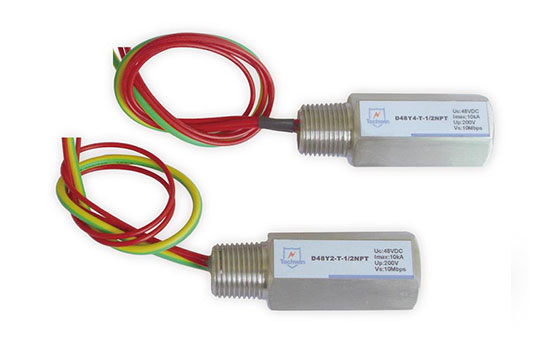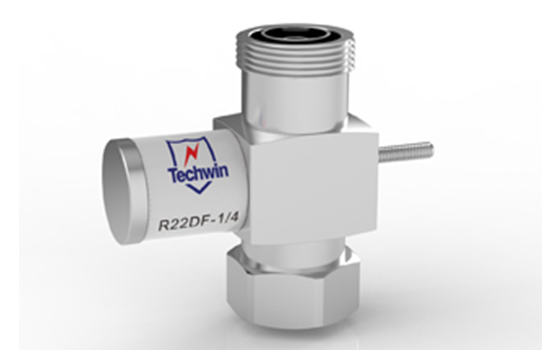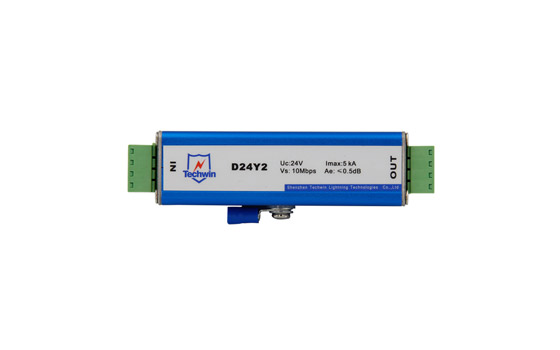

The whole set of lightning protection devices can be divided into flash catcher, lead wire, lightning protection and grounding device. Lightning protection device is to prevent the equipment from being struck by lightning through modern electricity and other technologies. Lightning protection devices within the lightning protection system components can be broadly divided into: power lightning protector, lightning protection socket, antenna lightning protector, signal lightning protector, etc.
Lightning rod, lightning line, lightning network and lightning protection are lightning protection system components of the receiver. They are used to protect the prominence of its parts higher than the protected object and lead the lightning to itself. Then, through the lead wire and grounding device, the lightning flow into the earth, so as to protect the protected object from lightning strikes. Flash receiver materials used should be able to meet the requirements of mechanical strength and corrosion resistance, but also should have sufficient thermal stability to withstand the thermal damage of lightning current.
The Lightning protector is connected in parallel to the protected equipment or facilities, normal devices and ground insulation. When there is a lightning over-voltage, the device and ground from insulation into conduction, and breakdown discharge. The lightning current or overvoltage will go into the earth to play a protective role. After the termination of overvoltage, the lightning protector quickly restores the inoperative state and resumes normal work. Lightning protection device is mainly used to protect electrical equipment and power lines, but are also used as a security measure to prevent high-voltage intrusion into the room. Lightning protection devices have protection gap type, tube type lightning arrester valve type lightning and zinc oxide lightning arrester. Low-voltage systems have power surge protectors and signal surge protectors are also called lightning protectors.
(1) Lead wire generally uses round steel or flat steel, with steel strand for the lead wire, its cross-sectional area shall not be less than 25 square millimetres. With non-ferrous metal wire for the lead wire, it should use a cross-sectional area of not less than 16 square millimetres copper wire.
(2) Lead wire should be laid along the exterior wall of the building, and should avoid bending, by the shortest way to ground.
(3) In using multiple lead wires, in order to facilitate the grounding resistance and check the connection of the lead wire, grounding wire, it is appropriate to set up a disconnect card at a height of about 1.8m from the ground in each lead wire.
(4) When the Lightning protection system components using multiple leads, the first and second class lightning protection buildings should have at least two leads. The distance between them shall not be greater than 12m and 18m. When the third class lightning protection building perimeter is more than 25m or height of more than 40m, there should also be two leads. And the distance between them shall not be greater than 25m.
(5) In places prone to mechanical damage, the ground below 0.3m to 1.7m above the ground a section of the lead wire should be added to the bamboo pipe, angle or steel pipe protection. Angle steel or steel pipe protection, should be connected to the lead wire to reduce the electric resistance through the lightning current.
(6) Lead wire cross-sectional corrosion of more than 30% should be replaced.
Grounding device is an important part of the lightning protection device. The grounding device is to discharge lightning current to the earth, limiting the lightning protection device to the ground voltage. In addition to an independent lightning rod and with the premise of the grounding resistance meeting the requirements, the lightning protection grounding device can be shared with other grounding devices.
As one of the leading surge protection manufacturers, we offer the following products:
lightning protection box, signal spd, DC power surge protector, spd telecom, etc.
 The difference of Type1/Type 1+2 SPD and Type 2 SPDAugust 11, 2023TECHWIN surge protectors offer reliable and efficient protection against power surges and electrical disturbances. Our range of surge protection devices includes Type 1/Type 1+2 and Type 2 SPDs, speci...viewPower Supply Protection Devices of Smoke and Heat Exhaust Ventilation (SHEV) SystemJune 26, 2024Smoke and heat exhaust ventilation systems (SHEV) play a critical role in enhancing building fire safety by ensuring smoke-free escape routes during a fire and providing residents with more time to es...viewHow to connect a surge protector?March 3, 2023Connecting surge protectors in an industrial setting requires additional considerations and precautions compared to connecting surge protectors in a residential setting. Here are some general steps to...viewUnderstanding The Technology Behind Lightning Protection Devices For Building StructuresJanuary 10, 2024In the field of building safety, the technology encompassed within lightning protection devices for building structures serves as a strong shield against the unpredictable nature of lightning. This pa...viewWhere to install surge protectors in a solar power systemMarch 14, 2023viewMaximizing Equipment Lifespan: Power Surge Monitoring for Industrial ApplicationsSeptember 11, 2023In industrial settings, where complex machinery and electronic equipment are the backbone of operations, ensuring the longevity and reliability of these assets is of paramount importance. Industrial e...view
 EN
EN
 jp
jp  ko
ko  fr
fr  de
de  es
es  it
it  ru
ru  pt
pt  ar
ar  vi
vi  th
th  ro
ro  bg
bg  nl
nl