
Many users focus heavily on parameters such as discharge current capacity, protection level and product class when selecting a Surge Protective Device (SPD). Yet they tend to overlook an equally critical issue: where should the SPD be installed and how should it be wired?
In fact, even a well‑performing qualified SPD may fail to deliver full protective performance if fitted in an improper location, with excessively long connecting conductors or inadequate earthing. It is fair to say that an SPD installed in the wrong position can see its protective effect drastically reduced.
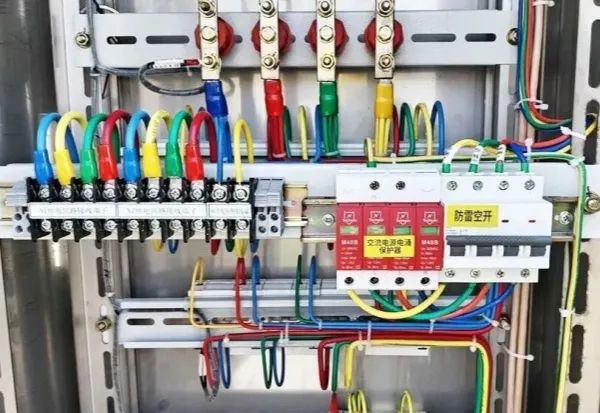
An SPD works by rapidly discharging surge energy and clamping over‑voltage to a level tolerable by end‑equipment when surges arise from lightning induction, lightning electromagnetic pulses or switching over‑voltages.
Nevertheless, surges are extremely transient high‑energy events. Excessive distance between the SPD and protected equipment, or overly long connecting cables, will introduce additional voltage drop across the conductors themselves.
This means the nominal protection level printed on the SPD nameplate does not equal the actual voltage experienced by the protected equipment.
Poor installation can compromise real‑world protection performance, no matter how favourable the SPD’s technical parameters are.
SPDs shall be mounted at critical points where surges may couple into the system, and kept as near as practicable to either the protected equipment or the incoming point of the power distribution system.
Typical bad‑practice examples include mounting the SPD at one end of a distribution cabinet while routing its connecting wires to the opposite end, or fitting the SPD far away from target equipment merely for construction convenience. Such layouts lengthen the surge‑current path and raise residual over‑voltage at the equipment terminals.
Accordingly, SPD installation is not simply “fit wherever space permits”. The core principles are proximity, short wiring and direct connection.
Subject to applicable codes and site constraints, connecting conductors for SPDs shall be kept as short as possible, with minimal unnecessary bends and detours. In engineering practice, the total length of SPD connecting leads is commonly optimised to preferably no more than 0.5 metres. Implementation shall comply with relevant standards, product datasheets and actual site conditions.
A complete lightning‑protection system cannot rely on a single high‑discharge‑capacity SPD to handle all surge risks.
From the power service entrance through downstream distribution branches to the front‑end of critical loads, different locations undertake distinct protective tasks. Front‑stage SPDs primarily dissipate large‑magnitude surge energy, while downstream units further suppress residual over‑voltage to deliver refined protection for sensitive hardware including PLCs, DCS systems, servers and communication apparatus.
Mismatch between SPD mounting location and system‑protection hierarchy will break the progressive‑protection chain, even if the SPD model is correctly specified.
Therefore, SPD placement is more than choosing which cabinet to house the device. What matters most is whether it sits at the correct electrical protection node.
Once triggered, an SPD must discharge surge current via a sound conductive path. Apart from installation position, reliable PE bonding and earthing systems are equally essential.
Issues such as over‑long earthing conductors, poor joint quality and loose terminals will degrade surge‑discharge performance. All connections shall be mechanically secure during installation, with superfluous cable length and sharp bends minimised.
A high‑quality SPD can realise its full protective potential only with correct installation.
In real‑world projects, equipment damage is not always caused by missing SPD hardware. Frequently, it results from incorrectly‑installed SPDs.
Proper model selection is merely the first step. Mounting position, wiring method, conductor length and earthing workmanship all directly determine final protection effectiveness.
From Techwin’s perspective, lightning protection is far more than “installing one surge protector”. It represents holistic protection covering product selection, system design, mounting layout and code‑compliant site execution.
An SPD is not effective just by being fitted. Correct positioning and standardised wiring ensure reliable surge mitigation every time.
When inspecting lightning‑protection measures for your power‑distribution system, start with one question:
Is this SPD really installed in the right place?
 Is Surge Backup Protector the Same As Surge Protector?March 13, 20231.The Role of Surge Backup ProtectorBefore the advent of surge backup protectors, the backup protection devices of SPD surge protectors typically used fuses or circuit breakers to separate the short-c...viewWhen Do You Need to Install Surge Protection Devices?October 9, 2024Frequent Thunderstorm Areas and Seasonal ProtectionIn regions where thunderstorm activities are frequent, especially during the summer thunderstorm season, it becomes particularly important to install...viewImportant differences between IEC 61643-01:2024 and IEC 61643-11:2011: ---Interpretation of the new standard for surge protectorsDecember 12, 2024The surge protector is an electronic device that provides safety protection for various electronic equipment, instruments, and communication lines. According to its use, it can be divided into power s...viewEco-Friendly Power: The Environmental Impact of SPD for Power SupplyJanuary 5, 2024In an era where environmental sustainability is a global priority, the deployment of Surge Protection Devices (SPDs) for power supply emerges as a crucial component in creating a greener and more resp...viewPower Surge Monitoring Device: Intelligent Monitoring and Power ProtectionOctober 9, 2024In modern life, electricity has become the cornerstone of our daily life and work. However, with the increasing complexity of the power network and the presence of unforeseen factors such as lightning...viewHow Does a Surge Protective Device Work?July 3, 2024Surge Protective Device (SPD) is a device used to protect electronic equipment from power surges or transient voltages. They are connected in parallel with the load power circuit that needs protection...view
 EN
EN
 jp
jp  ko
ko  fr
fr  de
de  es
es  it
it  ru
ru  pt
pt  ar
ar  vi
vi  th
th  ro
ro  bg
bg  nl
nl