
Are you worried that expensive photovoltaic solar systems might be damaged by voltage spikes? The reality is that without surge protection, even the slightest voltage spike can damage your solar panel array and related electronic equipment. Additionally, without lightning protection, your investment in energy efficiency would be pointless since lightning is one of the main causes of solar panel failure. This article provides the ultimate guide to purchasing SPD for solar, helping you provide the best protection for your photovoltaic solar system.
Solar panels are installed outdoors and are directly exposed to harsh conditions such as rain, wind, and dust. Among these weather conditions, lightning strikes require special attention as they can severely impact the safety and performance of the photovoltaic system.
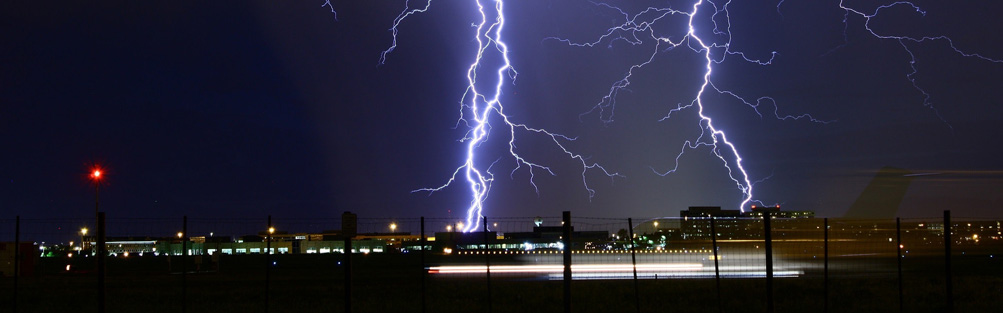
When lightning strikes the ground, it releases energy and affects the electric field on the ground. For photovoltaic solar stations, this brings two main risks:
Direct impact
Lightning can physically damage solar equipment on rooftops.
Transient overvoltage
Cables transmitting through magnetic coupling can cause damage to sensitive components such as printed circuit boards (PCB).
In areas with frequent lightning strikes, unprotected photovoltaic systems will suffer repeated and severe damage, leading to enormous repair and replacement costs, system downtime, and revenue loss. SPD for solar is designed to limit transient overvoltage and divert surge currents to the ground, ensuring the safety of electrical infrastructure and switching equipment.
Since photovoltaic power stations generate direct current (DC) electricity, inverters that convert this power from DC to alternating current (AC) are essential components. Unfortunately, inverters are not only highly sensitive to lightning strikes but also very expensive.
Both AC and DC lines require the correct selection and installation of suitable SPD. The number of SPDs installed in a photovoltaic solar system depends on the distance between the panels and the inverters:
When the cable length between solar panels is less than 10 meters: Install 1 SPD at the inverter, combiner box, or near the solar panels.
When the DC cable exceeds 10 meters: More surge protectors are needed at both the inverter and the solar module end of the cable.
SPD for solar protects the system by controlling transient voltage and redirecting the current back to its source or to the ground when a transient voltage occurs in the protected circuit. The key component is the metal oxide varistor (MOV), which switches between high impedance and low impedance states under different conditions.
At typical operating voltage, SPD for solar remains in a high impedance state and has no effect on the photovoltaic solar system. When a transient voltage occurs in the circuit, SPD switches to a conduction state (or low impedance), redirecting the surge current back to its source or to the ground, keeping the voltage at a safer level. After the transient transfers, SPD automatically resets to a high impedance state.
Photovoltaic solar systems have high DC system voltages up to 1500 volts, requiring specially designed SPDs. Different SPD protections are crucial for the AC and DC sides, with specific DC surge protectors needed for the DC side and AC surge protectors for the AC side. It is dangerous to incorrectly use an AC or DC SPD in case of failure.
In photovoltaic solar applications, SPDs are categorized into three types based on their resistance:
Type 1 SPD: Counters direct strikes that bring energy surges.
Type 2 SPD: Reduces overvoltage from multiple sources.
Type 1+2 SPD: Combines the characteristics of both, providing complete protection.
When choosing a suitable SPD model for a photovoltaic solar system, keep the following points in mind:
Lightning density
System operating temperature
System voltage
System's short circuit current rating
Waveform level to be protected
Nominal discharge current.
By correctly selecting and installing suitable SPD for solar, you can ensure the long-term safety and efficient operation of the photovoltaic solar system.
 How do SPDs work?March 3, 2023SPD stands for Surge Protective Device, which is a device that is designed to protect electrical and electronic equipment from voltage surges and transients. Here is a brief explanation of how SPDs wo...viewWhat is the Residual Voltage of the Surge Protector?March 23, 2022What is the residual voltage of the surge protector? When the SPD device is selected and adapted, its various parameters will be comprehensively considered, and a comprehensive selection will be made....viewWhat is the Difference Between a Class 1 Lightning Surge Protector and a Class 2?November 9, 2021Since the energy of lightning strikes is very huge, it is necessary to gradually discharge the energy of lightning strikes to the ground through a hierarchical discharge method. The first-level lightn...viewLightning Protection Scheme for Drone Ground Control Station - Focus on SPD ConfigurationOctober 31, 20251.Core Principle: Zoning and Staged ProtectionThe Ground Control Station (GCS)—whether a fixed building, shelter, or vehicle—must be treated as a system requiring multi-layered protection. Adhering ...viewThe Importance of Lightning Protectors in Protecting Home Appliances and ElectronicsFebruary 29, 2024In today's digital age, our homes are filled with a multitude of electronics and appliances that we rely on daily. From televisions and computers to refrigerators and washing machines, these devic...viewThe Position of Installing Surge ProtectorMarch 23, 20221. Where to install surge protector?The position of the surge protector: the surge protector is an important component of the lightning protection project in a building, so the location of the surge prote...view
 EN
EN
 jp
jp  ko
ko  fr
fr  de
de  es
es  it
it  ru
ru  pt
pt  ar
ar  vi
vi  th
th  ro
ro  bg
bg  nl
nl