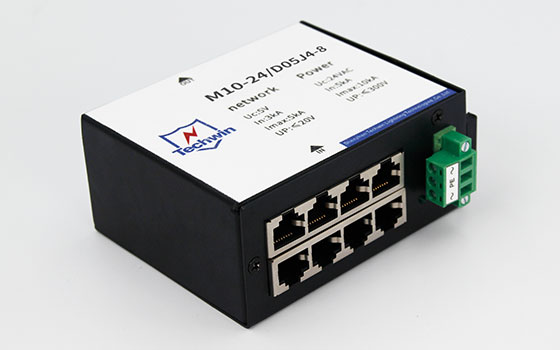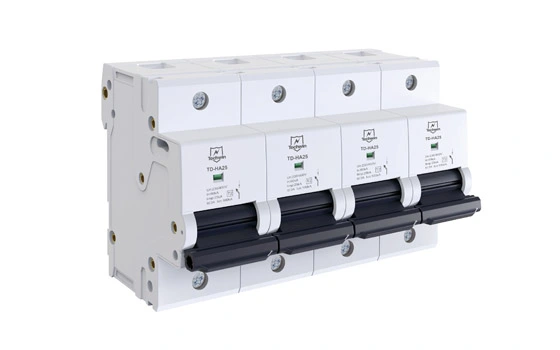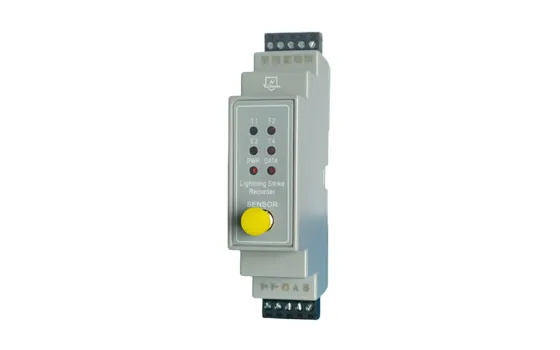


The discharge gap of the surge protective device is generally composed of two metal rods exposed to the air and separated by a certain gap. One of the metal rods is connected to the power phase line L1 or neutral line (N) of the required protection equipment, and the other A metal rod is connected to the ground wire (PE). When the instantaneous overvoltage strikes, the gap is broken down, and a part of the overvoltage charge is introduced into the ground, avoiding the voltage rise on the protected equipment. The distance between the two metal rods in the discharge gap can be adjusted as required, and the structure is relatively simple, but the disadvantage is that the arc extinguishing performance is poor. The improved discharge gap is an angular gap, and its arc extinguishing function is better than the former. It relies on the action of the electric power F of the circuit and the rising action of the hot air flow to extinguish the arc.
It is composed of a pair of cold cathode plates separated from each other and enclosed in a glass tube or ceramic tube filled with a certain inert gas (Ar). In order to improve the triggering probability of the discharge tube, there is also a triggering aid in the discharge tube. This kind of gas-filled discharge tube has two-pole type and three-pole type. The technical parameters of SPD surge gas discharge tube mainly include: DC discharge voltage Udc; impulse discharge voltage Up, in general, Up≈(2~3)Udc ; Power frequency and current In; Impulse and current Ip; Insulation resistance R (>109Ω); Inter-electrode capacitance (1-5PF) Gas discharge tube can be used under DC and AC conditions, the selected DC discharge voltage Udc They are as follows: Use under DC conditions: Udc≥1.8U0 (U0 is the DC voltage for the line to work normally) Use under AC conditions: Udc≥1.44Un (Un is the effective value of the AC voltage for the line to work normally).
It is a metal oxide semiconductor nonlinear resistor with ZnO as the main component. When the voltage acting on both ends reaches a certain value, the resistance is very sensitive to the voltage. Its working principle is equivalent to the series-parallel connection of multiple semiconductor P-Ns. The surge protective device varistor is characterized by good nonlinear characteristics, large current capacity, small normal leakage current, low residual voltage (depending on the working voltage and current capacity of the varistor), fast response time to transient overvoltage, no continuous flow.
The suppressor diode has the function of clamping and limiting voltage. It works in the reverse breakdown region. Because of its low clamping voltage and fast response, it is especially suitable for use as the last-level protection element in multi-level protection circuits. The volt-ampere characteristics of the suppression diode in the breakdown region can be expressed by the following formula: I=CUα, where α is the nonlinear coefficient, for Zener diode α=7~9, in avalanche diode α=5~7.
The choke coil is a common mode interference suppression device with a ferrite core. It consists of two coils of the same size and the same number of turns wound symmetrically on the same ferrite toroidal core to form a four-terminal device, which has a suppressing effect on the common-mode signal with a large inductance, but has little effect on the differential-mode signal with a small leakage inductance. The choke coil of the surge protection device can effectively suppress common mode interference signals (such as lightning interference) in balanced lines, but has no effect on the differential mode signals normally transmitted by the line.
 When Do You Need to Install Surge Protection Devices?October 9, 2024Frequent Thunderstorm Areas and Seasonal ProtectionIn regions where thunderstorm activities are frequent, especially during the summer thunderstorm season, it becomes particularly important to install...viewSurge Protector: Safeguarding Your Devices from Power FluctuationsJanuary 5, 2024The Vulnerability of Electronic DevicesIn the digital age, our lives are intricately woven with electronic devices, from smartphones to laptops and everything in between. However, these devices are no...viewHow does A Surge Protective Device ( SPD ) work?April 16, 2025A Surge Protective Device (SPD) is designed to protect electrical systems and equipment from voltage spikes or surges. These surges can occur due to lightning strikes, power outages, or switching even...viewHow Does a Surge Protective Device Work?July 3, 2024Surge Protective Device (SPD) is a device used to protect electronic equipment from power surges or transient voltages. They are connected in parallel with the load power circuit that needs protection...viewChoosing the Right Power Surge Monitoring Device for Your HomeSeptember 11, 2023In an era where our homes are filled with a multitude of electronic devices, ensuring their safety and longevity is paramount. Power surges, often caused by electrical fluctuations or lightning strike...viewThe Importance of Lightning Protectors in Protecting Home Appliances and ElectronicsFebruary 29, 2024In today's digital age, our homes are filled with a multitude of electronics and appliances that we rely on daily. From televisions and computers to refrigerators and washing machines, these devic...view
 EN
EN
 jp
jp  ko
ko  fr
fr  de
de  es
es  it
it  ru
ru  pt
pt  ar
ar  vi
vi  th
th  ro
ro  bg
bg  nl
nl