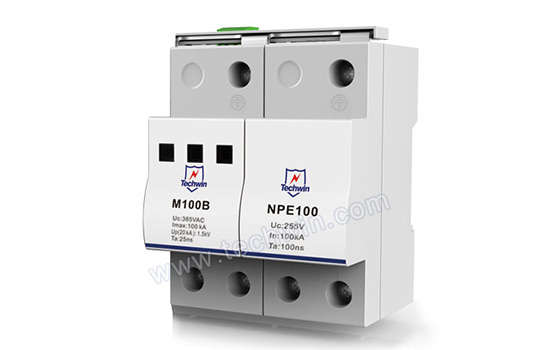

Power supply surge protection for industrial control panels is not just a recommended practice but an essential legal requirement, a mandatory measure to protect electrical systems. Typical control panels are usually equipped with backup fuses larger than 315A, and the distribution board's surge protector works alongside the backup fuses. These backup fuses have high demands on cable length and protection levels, making the installation of surge protectors particularly important.
Control panels can be seen as central power hubs connecting various electrical devices, making them susceptible to events such as lightning strikes and surges that can lead to equipment damage, surge interruptions, and downtime losses. Here are the main benefits of power supply surge protection for industrial control panels:
Surge protection effectively prevents overvoltage from entering the electrical infrastructure through the control panel, extending the lifespan of the equipment and avoiding costly damage and interruptions.
Surge protection helps prevent faults caused by power surges, ensuring continuous operation of industrial and commercial facilities. This is especially crucial for critical production and operational environments.
Surge protection reduces the risk of fires and personal injuries that surges might cause, ensuring workplace safety is a top priority.
In the long term, surge protection significantly reduces costs by lowering equipment replacement costs, reducing downtime losses, and cutting maintenance expenses.
Given these significant advantages, it is crucial to install surge protection devices in the control panel's distribution board. Surge protectors in the main distribution box can discharge most of the overcurrent, but relying solely on the main distribution box's protection may not fully protect the entire system, as residual energy could still reach sensitive electronic equipment. Therefore, terminal surge protectors must always be installed close to the equipment.
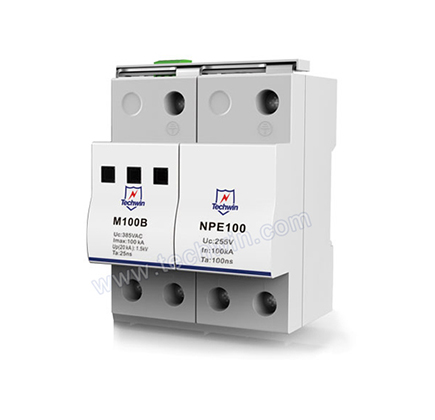
Installing a Type 1 SPD at the entry point of the electrical system as the first line of defense against voltage spikes and surges entering the electrical system is crucial. This primary protection measure effectively prevents surges from further spreading into the building's wiring system and eventually reaching sensitive electronic equipment.
The closer the distance between the surge protector and the main power source, the more effective the protection. Installing surge protectors at the entry point can significantly reduce the risk of voltage spikes affecting sensitive equipment.
However, it is impossible to discharge 100% of overvoltage at once, requiring the installation of Type 2 SPD close to the equipment for precise protection of sensitive equipment.
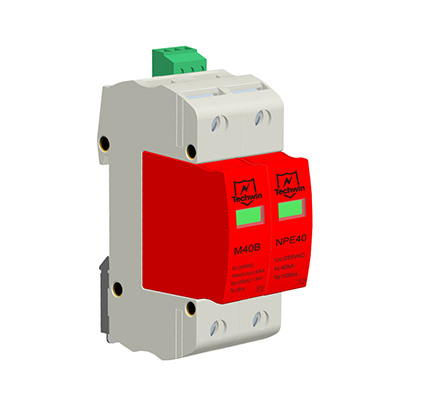
The faster the response of the surge protector to transient events, the better it can transfer excess energy away from the equipment. Installing surge protectors close to the equipment can shorten the distance a surge must travel before encountering the protection device.
Tailor-made Type 2 SPDs for specific circuits or devices are usually installed near the equipment for more precise protection of each circuit or device. These protective devices must be installed in series with the main surge protector to ensure effective protection at all levels during a surge event.
If a surge protector exceeds its capacity limit, it may be damaged due to a short circuit. Additional protective devices must be installed in series upstream of Type 2 SPD.
A short circuit occurs when a low-resistance connection is accidentally established between two conductors in the electrical system.Type 2 SPD must have a short-circuit current rating (ISCCR) at least equal to the short-circuit current at the connection point.
When the main distribution box uses a TN-C system, a maximum distance of 3m is required, and another 0+0.5 configuration lightning protector is needed.
 Benefits of Using Lightning Protection DevicesMarch 1, 2024In today's fast-paced world, where technology reigns supreme, the importance of protecting our electronic devices from potential damage caused by lightning strikes cannot be understated. This is w...viewProtecting Your Business Investments: The Role of Power Surge MonitoringSeptember 11, 2023In today's business landscape, where technology plays a central role in operations, safeguarding your electronic assets is paramount. Power surges, those sudden, unpredictable spikes in electrical...viewThe difference of Type1/Type 1+2 SPD and Type 2 SPDAugust 11, 2023TECHWIN surge protectors offer reliable and efficient protection against power surges and electrical disturbances. Our range of surge protection devices includes Type 1/Type 1+2 and Type 2 SPDs, speci...viewHow Does A Surge Protection Device Work?August 30, 20211. Learn what is a power surge before undersanding a surge protection deviceFirstly, you need to understand what a power surge is before understanding how a surge protection device works. When the vol...viewProtect Your Surveillance: The Importance of Surge Protectors for CCTV CamerasJune 6, 2024In today's world, ensuring the safety and security of your property is more crucial than ever. Closed-circuit television (CCTV) cameras have become an essential tool in monitoring and safeguarding...viewUnderstanding the Function and Installation Method of Surge Protection BoxJuly 3, 2024As computer networks become increasingly integrated into people's lives and work, heralding the advent of the digital and information era, the importance of data center rooms and lightning protect...view
 EN
EN
 jp
jp  ko
ko  fr
fr  de
de  es
es  it
it  ru
ru  pt
pt  ar
ar  vi
vi  th
th  ro
ro  bg
bg  nl
nl